
The Rich History of Tzabaco Rancho Vineyards
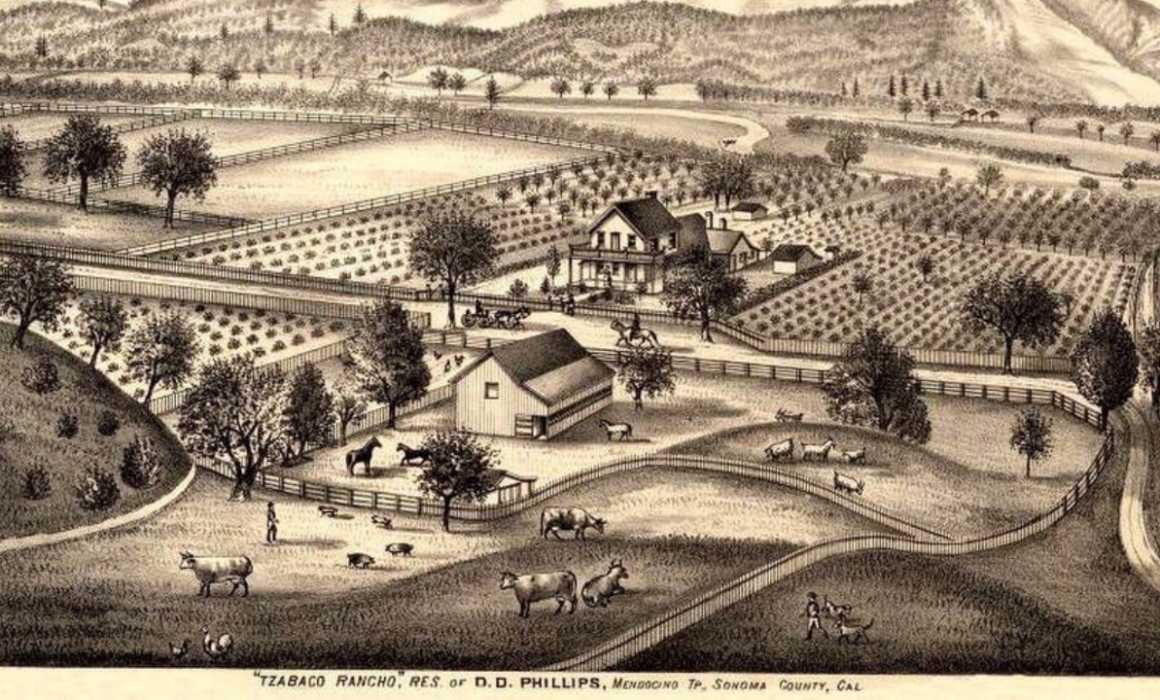
In the heart of Dry Creek Valley, Tzabaco Rancho Vineyards’ grapegrowing history goes back to 1856 and a man named Duvall Drake (D.D.) Phillips, a 49er from Kentucky who bought part of an historic rancho and planted 45 acres of Zinfandel.
But Phillips is just the beginning of the story. For Tzabaco Rancho’s history goes even farther back than that, to a teenager named José de German Antonio Piña (sometimes written as Pena) who was granted 17,000 acres by the Mexican government in 1843, when he was just 14 years old.
This was a fraught time for young men like Piña, as former Healdsburg Museum executive director Hannah Clayborn has documented.
“His youth underscores several conditions on the Mexican California frontier,” she writes.
“One was the readiness of Mexican officials to grant land to almost any eligible Mexican citizen in order to block the gradual encroachment of the Russians on their northern border. Ever since the Russian-American Company commandeered control of the river they called Slavianka by establishing a commercial port at Bodega Bay and a colonial Fort Ross in 1812, Spanish authorities had viewed the Russians with mounting suspicion. The Russians could make use of the Russian River as a natural highway to the interior by surrounding its mouth at present-day Jenner.”
Russians were increasingly spreading inland to set up farms and ranches to grow wheat and produce. As a result the Mexican government began a “concerted effort to foster settlement in the north.”
General Mariano Vallejo who was in charge of Sonoma set up another presidio in 1833 somewhere along the Russian River, but it didn’t last long. Other forts were also attempted to no avail. Vallejo was undeterred though, writing that it was his “eager desire to colonize all the valley and hills whose bases were bounded by the Russian River.”
He thus took exclusive control of land grants in the north and followed Mexican government policy to grant lands to soldiers and officers of the Mexican presidios.
Piña’s father, who had come to California in 1819, was both a soldier and the right-hand man of Vallejo. Piña’s mother’s father had also served. As a thank you, the elder Piña was granted 2,800-acre Rancho Agua Caliente, a land offering that extended from the town of Sonoma to present-day Kenwood.
By 1840, his son started looking around. He tried first to settle on the 48,800-acre Sotoyome Rancho in Alexander Valley and was told by Cyrus Alexander it was already taken before settling in Dry Creek Valley, when it was known as the Tzabaca/Tzabaco Valley, and moving into an adobe dwelling with his brother.
On September 14, 1843 he applied formally for the land. By 1847 he was dead, and the land was divided equally between his four surviving brothers and a sister, the rancho appraised at just $1.18/acre.
But once California became a part of the United States, the family fell into debt and the Rancho was sold at public auction in 1850, divided into parcels.
October 1856 is when D.D. Phillips comes along, buying 137-and-a-quarter acres, including the adobe. His son Oscar added to the family holdings buying property at 5796 Dry Creek Road and moving into the adobe in 1901. The sixth generation, Brian and Janice, live on the property now.
Brian oversees farming while Janice is a trained enologist who worked 20 years for Jordan Winery alongside Rob Davis and Andre Tschelistcheff. She made her family’s Estate 1856 Winery wines, a Petit Verdot, Malbec, and Cabernet Sauvignon.
The family also farms fruit orchards, vegetable gardens, and livestock as well as several other varieties of wine grapes, which are sold to Rodney Strong Vineyards and J. Cage Cellars among others.
Seventh-generation Tom and Audrey Schmidt are keeping the legacy alive, looking after not only Tzabaco Rancho Vineyards but Dry Creek Flowers, Audrey’s flower farm.
Vineyard visits by appointment are available by calling Tom at 707-484-3215 or emailing info@tzabacoranchovineyards.com.
