
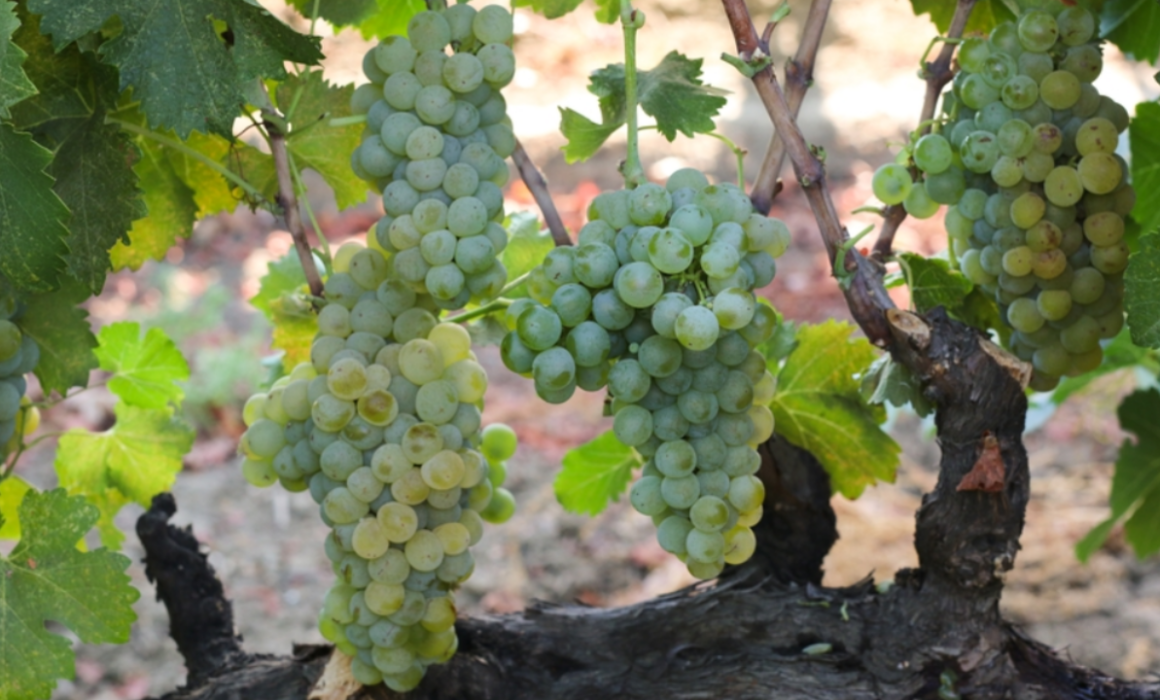
Semillon in Sonoma County
Semillon has never been one of the dominant grape varieties in California, let alone Sonoma County, but that doesn’t mean it doesn’t have a role to play and that it wasn’t important at different points in our history.
A white Bordeaux variety like its more popular sister, Sauvignon Blanc, with which it is often blended, Semillon’s arrival in California is not well-documented, though it is known to have been among the vines brought to Sonoma County from Europe by Agoston Haraszthy in 1862, five years after he bought Buena Vista Ranch.
Historian Charles Sullivan writes in “A Companion to California Wine,” that Semillon was also imported by J. H. Drummond, who established Dunfillan Vineyards in Sonoma Valley, and Charles Wetmore in the Livermore Valley between 1878 and 1880. H.W. Crabb had it in his Oakville vineyard by 1881, and by 1885 it could be found throughout the vineyards of northern California sold as “Sauterne,” after the famous “Noble Rot” botrytised wine of Bordeaux, or as “Haut Sauterne.”
Monte Rosso Vineyard on Moon Mountain has some of the world’s oldest Semillon still in the ground, just under four acres of dry-farmed, head-trained vines at 1,000-feet elevation that date back to 1886. It is interplanted with Palomino, Burger, Sylvaner, Lenoir, and Pinot St. George. Only Australia’s Hunter Valley has older Semillon.
By the 1960s, more varietal Semillons were being made but by the 1990s acreage began to decline, despite the efforts of the Society of Semillonards, founded by Sonoma County’s own Dan Berger.
In a 1993 story in the Los Angeles Times, where Berger served as a wine writer for many years, he wrote, “Of all the white wines I have in my cellar, Semillon ages best. Second in the race is Sauvignon Blanc, with Chardonnay a distant third.”
He continued, “This led to the formation of the Society of Semillonards, a limited membership organization (there are three of us) that meets regularly to pair seafood and Semillon and to revel in the joys of a grape variety that is appreciated by winemakers but fairly unknown to most American wine consumers.”
He further extolled its age ability, writing, “Also, Semillon does quite an amazing thing in the bottle. Over time, the fruity elements close down a bit and are replaced by a classic hay and honey complexity that works even better with food than do the younger versions.”
Today there remain about 550 acres of Semillon in California, of which 95 are in Sonoma County. Semillon likes well-drained soils and requires good spacing to avoid rot (unless you’re looking for that). It has a short window of ripening and can get overripe fast, leading to flabby wines.
But the high-acid variety does age well, can be invitingly salty, with lovely citrus and honeysuckle aromatics, high-yielding with sizable cluster weights.
In 2025 a “Sem-Posium” was held at Lambert Bridge Winery to discuss “Semillon Across Borders: Industry Focus and Inspired Wine Culture.”
Lambert Bridge GM/Winemaker Jennifer Higgins makes a Semillon from Sei Querce Vineyards in Alexander Valley she describes as feeling “like a warm welcome home,” full of honey, yellow peach, apricot, and delicate floral notes, “the kind of wine that invites good conversation, shared meals, and lingering moments around the table.”
In 2020 she also produced a Cuvee Sigalas Lambert Sauternes in collaboration with Laure de Lambert Compeyrot of Chateau Sigalas Rabaud in Bordeaux.
Brenae Royal, who managed the historic site for many years, makes a Monte Rosso Semillon for her own brand, Violet’s Paradise. She describes it as layered in honeydew, wet stone, and citrus blossom with vibrant acidity and a refined mineral edge.
Component Wine Co. also makes a Semillon from Monte Rosso. They put no new oak on it, and do extended lees contact, describing the resulting wine as silky, aromatic, and salty.
Bedrock Wine Co. took cuttings of Semillon from Monte Rosso in 2019 to plant on the Sonoma Valley floor.
Among the wineries sourcing those grapes are Extradimensional Wine Co., which has been making skin-fermented Semillon for many years but started working with Bedrock fruit in 2023, producing only 95 cases of the 100% varietal white. Fine Disregard also made a Bedrock Semillon in 2023.
Also from Sonoma Valley comes Turks Head Semillon, who get grapes from Wildwood Vineyards, originally planted in 1882.
There’s Semillon at the historic Nervo Ranch (planted 1896) in Geyserville farmed by Bedrock and Grace Vineyard Management.
And lastly, Peter Michael Winery in Knights Valley makes a highly sought-after 50-50 blend of estate-grown Semillon and Sauvignon Blanc called Coeur a Coeur (Heart to Heart). They age each variety separately on the lees with a gentle battonage before making the final cuvee.
Photo By: Foundation Plant Services – University of California, Davis
