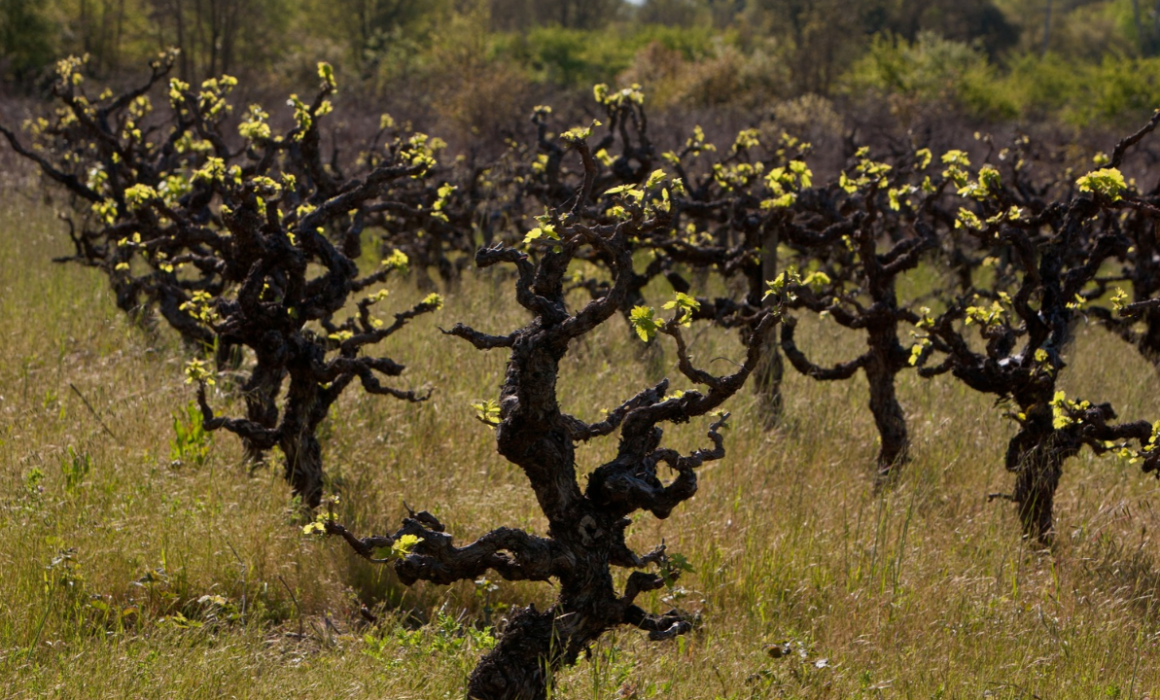
A Million Stories: The Old Vine Registry
A crowdsourced global database of living historic vineyard sites, The Old Vine Registry (OVR) website was launched in 2023 to gather the most accurate, in-depth data on old-vine vineyards in the world.
By accumulating all this information in one place the registry’s hope is to enable the discovery of and appreciation for these magical historic sites and just maybe, help preserve them by enhancing their economic value and providing a return on investment to the grapegrowers who maintain them.
Why do old vines matter? The OVR states that, “from a scientific perspective, we can discover and learn a great deal about vineyard resilience, survival and adaptability from studying individual plant genetic make-up, vineyard genetic diversity, physiology, location, viticultural treatments and practices, soil and geology, and surrounding environment,” from vines that have survived so many challenges over a long period of time.
Understanding old vines will help understand future vines, in other words. But there are also a million stories hidden between the leaves. Those are worth unearthing and preserving, too.
Jackson Family Wines provided a generous grant to help launch the non-profit OVR, which was largely created by Jancis Robinson, Tamlyn Currin and Sarah Abbott, who also created the Old Vine Conference, which was held last year in Sonoma County. California-based wine writer Alder Yarrow is also involved.
At present, the database includes information on 12,677 vineyards from 39 countries, representing more than 117,105 acres (47,391 hectares) of land. To qualify, at least 85% of the vines in a given site must be at least 35 years old, or if grafted, the grafts must be 35 years old.
Where relevant, every vineyard page also includes a link to wines that might be available to buy from specific old-vine vineyards via Wine Searcher, making the connection between vines and wines easier for consumers.
To that end, a new OVR Seal was created recently to give producers and trade organizations a way to communicate a wine’s documented history more overtly. It may be used on bottles, websites, marketing materials, and e-commerce listings. The seals come in several age categories: 35+ years, 50+ years, 75+ years, 100+ years, and 150+ years.
An advanced search for registered old vineyards within Sonoma County currently returns 207 results. Napa only has 82. Mendocino has 45. The richness of Sonoma County’s old vines thus is well-represented, a testament to the long legacy of multigenerational farming here.
It includes such listings as the Stryker Vineyard in Alexander Valley planted in 1925 formerly owned by Stryker Sonoma. It is now part of Foley Sonoma. On the other end of Alexander Valley, J. Rickards Winery’s Brignole Vineyard was planted by Rosa Brignole in 1908, who put in Zinfandel and Petite Sirah, but also Chasselas and Mataro, with many varieties as of yet unidentified.
Born in 1888 in Genoa, Italy, Rosa Rocca Brignole is a fascinating story. She and her husband Giovanni came to live on a 360-acre ranch in Asti owned by a San Francisco industrialist Mark John Fontana (who had also immigrated to California from Italy to work in the fruit canning industry) and managed by Giovanni. In 1919 Rosa acquired it. In 1940 she and her daughter Josephine were both poisoned from botulism bacteria in canned figs. Rosa died, only 51, leaving behind four children, “held in high esteem by all who knew her,” read the obituary. J. Rickards holds an annual Rosa Brignole Celebration Day every August.
Going further back is Alegria Vineyard tended to by Betsy and Bill Nachbauer in the Russian River Valley. The majority of its plantings date back to 1890 and include such rarities as Beclan (native to the Jura), Palomino (famous in Spain for making Sherry) and Negrette.
Anthill Farms has made a mixed red from the Peugh Vineyard in Russian River Valley, a head-trained, own-rooted, dry-farmed site planted in 1887 to Zinfandel, Grenache, Petite Sirah, Alicante Bouschet, Carignan, Mourvedre, Barbera, Malvasia Nera and a field blend of unknowns, both red and white. Anthill Farms as well as Read Holland have made Chardonnays from Peugh, with vines grafted to the variety in 1944.
Bedrock Wine Co.’s Alta Vista Vineyard in Sonoma Valley has Gewurztraminer planted in the 1930s. The 36-acre Bedrock Vineyard itself was planted in 1888. The Barricia Vineyard in Russian River Valley, whose Zinfandel was a well-loved, single-vineyard wine from Ravenswood, was likely planted in 1888 or 1892. Nearby Lasseter Ranch, formerly known as Mancuso Vineyard or Morse Vineyard, was established in 1919.
Out on the Sonoma Coast in Fort Ross-Seaview, a place like Hirsch now qualifies, its Pinot Noir vines first planted in 1990 on AXR at 1,348-feet elevation on what it calls the East Ridge. Those plantings were preceded by earlier vineyards like Bohan 1974 (planted in 1974) and Bohan 1980s (planted in 1979, 1980 and 1988), owned by George and Nikki Bohan. Head-trained and dry-farmed since the beginning, the Pinot is thought to be a Martini selection. There’s also Trousseau, Chardonnay and Riesling on Bohan 1980s.
More than 200 registered vineyards from Sonoma County equates to more than 200 incredible stories of grit and perseverance, the vines adapting to survive over all their many decades, with farmers sustaining them and keeping them in the ground. If you’ve got a qualifying site in Sonoma County, add it to the list, and contribute another chapter to the region’s exceptionally long-lived winegrowing tome.