
The Soil’s Alive She Said
Travel the world of wine and what’s the number one thing people want to talk about? Soil. Soil pH, soil water retention, soil diversity, soil. Yes, climate’s in there too, but what’s the saying? You can’t change the weather. You can take care of your soil.
Dr. Elaine Ingham was one of the world’s experts on soil microbiology, a soil biology researcher who founded Soil Foodweb Inc. and the Soil Foodweb School. She spent a lot of her time teaching at Oregon State University and served as a chief scientist at The Rodale Institute for a while. She came to California to direct research at the Environment Celebration Institute’s farm. She died in February at the age of 73.
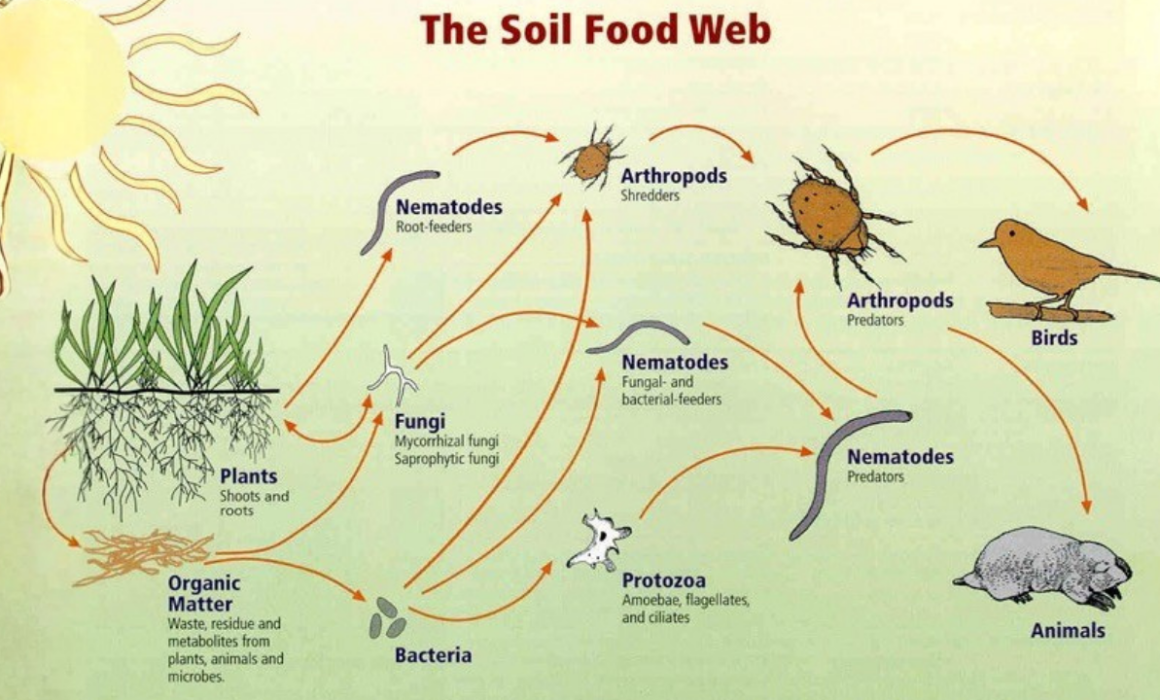
Soil Foodweb worked with testing labs to assess soil biology. What’s become widely known as the Soil Food Web is a complex living system comprised of a community of organisms that take energy from the sun and convert inorganic compounds into energy-rich organic compounds.
Through photosynthesis carbon dioxide and minerals become plant material able to exude acids, sugars and ectoenzymes as well as energy-rich nectar that feed the food web, adjusting pH along the way. Earthworms, nematodes, insect larva and other organisms are part of this system.
Understanding soil as a complex realm of microorganisms was the life work of Dr. Elaine, as she was known, the New York Times this week crediting her as “largely responsible for the understanding by gardeners and farmers that soil is alive.”
“Her research upended a common view that a plant simply sucks nutrients through its roots like a straw,” it said. “She showed that plants actively orchestrate an underground world. Plant roots exude sugars to attract bacteria and fungi, which in turn nourish the roots and protect them from parasites. Protozoa and nematodes also play crucial roles in the soil food web.”
Dr. Elaine helped others understand that by managing the soil beneath a plant, growers could prevent pests and diseases above ground, protect against erosion and retain water.
Here in Sonoma County, part of the reason there are more than a dozen American Viticultural Areas, or AVAs, is because of differences in soil. Dramatic geological moments over millennia have resulted in 11 major formation types, 31 different soil series within those types, and permutations within each series too numerous to count.
The Chalk Hill AVA has rocky, chalk-like soils, while much of the Russian River and Green Valley AVAs are rich in fluffy, well-draining Goldridge series soils, which stretch north to Annapolis all the way to the Sebastopol Hills. The soil was named after Luther Burbank’s Gold Ridge Farm in Sebastopol.
Dr. Daniel Roberts, who holds a doctorate in soil science (aka Dr. Dirt), often called Goldridge his favorite soil; easy to grow high-end fruit. Winemakers have also described it as having a moon dust effect, resulting in wines that are weightless with concentration.
The Dry Creek Valley has rocky gravel and red clay soils that drain well, while Moon Mountain has iron-rich volcanic terrain. Rugged Rockpile is brimming in shallow red-brown clay. Alexander Valley is a wealth of alluvial dirt that continues into Knights Valley. Sonoma Valley can be loamy on the flats, rocky on the hillsides. Carneros has a lot of shallow clay-loam.
The popular idiom, “take care of the soil and it will take care of you,” is credited to Hugh Hammond Bennett (1881-1960), the first chief of the Soil Conservation Service, known as the Father of Soil Conservation. He spent his career particularly concerned about erosion after seeing the effects of drought and dust storms in the 1930s on Dust Bowl farmers.
Much has been learned and applied since then.
