
Hey, Hey Gamay
Last harvest, 2025, Ridge Vineyards worked with a new grape for the first time in its storied history: Gamay Noir.
Known for being high in acid and low in tannin, the Gamay grapes came from Ponzo Vineyard in the Russian River Valley, where Ridge has long sourced Zinfandel. It describes the underdog status of the variety thusly: “In 1395, Gamay was banned by the Duke of Burgundy for being ‘despicable and disloyal’ due to the grape’s unfamiliar taste and texture. He wanted to ensure that the land would continue to be used to produce Pinot Noir, which he saw as a more respectable wine.”
It was also banned for being more prolific. So the French moved south and planted Gamay in Beaujolais, where it is named for a hamlet on the Cote de Beaune. An ancient grape whose history dates as far back as the 14th century, it goes into the wines of Mâconnais, Coteaux Bourguignon, Bourgogne Passe-Tout Grain, and Crémant de Bourgogne sparkling wines.
Like Pinot, the juice from Gamay is colorless while the grapes can become nearly black in color (thus the Noir descriptor). The wines tend to be fleshy, fruity, and sizzlingly vibrant, sometimes peppery with softened tannins.
Growing Gamay amidst the Russian River Valley’s hallowed Pinot Noir fields could be seen as equally rebellious. But Ridge is excited about its potential, viticulturalist David Gates explaining that Bob Ponzo came to him years ago after pulling Merlot vines and asked if he wanted him to plant more Zinfandel.
Instead Gates asked for Gamay, sourcing the only Gamay clone available in any quantity in California, ENTAV 358, from Max Reichwage of Reichwage Winery in the Sebastopol Hills for Ponzo.
Ponzo Vineyard is just south of Healdsburg at the northernmost edge of the Russian River appellation in an area well-known for Pinot Noir as well as Zinfandel. Some of the Zin is interplanted with Petite Sirah and dates back to 1952. At just 100 feet above sea level, the site gets the area’s early morning fog and late burn-off.
Reichwage’s estate vineyard is Twin Hills, which dates back to the 19th century. It became Twin Hill Ranch in 1942 and was focused on apple farming and packing until 2010. Reichwage bought it in 2014, the orchards largely abandoned. Of the 20 acres, nine are planted to vines, including, of course, Gamay, and three to apples.
Gamay is a rarity in Sonoma County, not able to crack even the top 13 list of most valued red varieties. There’s more Carignane, Mataro/Mourvedre, Sangiovese, and Petit Verdot than Gamay Noir here.
Across California, it’s so uncommon it barely gets a mention on the California Grape Acreage Report either, where even such randoms as Lagrein, Durif, Dornfelder, and Muscat Hamburg make an appearance. There, it’s listed synonymously with Valdiguie (aka Napa Gamay, which is not the same as Gamay Noir), of which 229 acres are accounted for across the state. There’s more Touriga Nacional and Tannat in California.
But what there is, is well worth seeking out, beloved by a cadre of winemakers who are giving Gamay Noir its proper due.
Producers beyond Ridge and Reichwage include Jolie-Laide, Breaking Bread (the side label of Kokomo’s Erik Miller), and Samuel Louis Smith.
Jolie-Laide gets its Gamay grapes from two sites, one in the Fountaingrove AVA in iron-rich volcanic soils and the other on the northern end of Sonoma County. It also makes a Rosé of Gamay that’s incredible, salty, fruity, and crisp.
Miller also sources from the Fountaingrove District for his 100% Gamay, fermenting 100% whole-cluster to make a traditional Cru Beaujolais style in 2022, his first vintage. His grapes are grown in a 1/3-acre vineyard in his own backyard. He describes it as “slightly warmer than Burgundy” and the wine “richer than Pinot Noir” with “an array of red fruit flavors along with a streak of minerality and a touch of dusty bubblegum.”
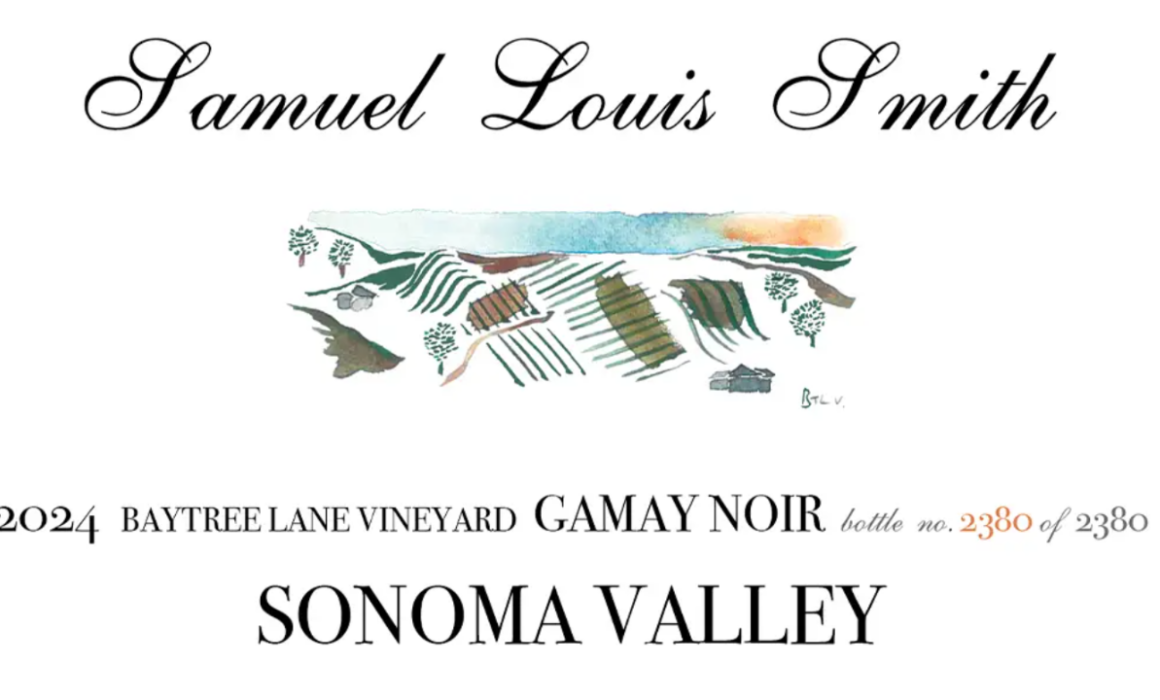
Smith sources from the Baytree Lane Vineyard in Sonoma Valley at the foot of Sonoma Mountain near the Petaluma Gap AVA.
Darling Wines’ Gamay also comes from Baytree Lane Vineyard, as does Obsidian Wine Co.’s Vin Chanmé Gamay Noir. Grown by twin brothers Mike and Doug Hengehold, back in 2014 the brothers thought they were planting Pinot Noir, but in 2023 realized after testing that one of the “clones” of Pinot Noir was actually Gamay Noir and five of their 10 acres were too.
Tin Barn Vineyards is another Sonoma County producer making a Baytree Gamay, as are Scribe, Trail Marker Wine Co., and Fieldhand Vineyards.
Pellegrini Olivet Lane makes a Gamay from head-trained vines at the Turner Vineyard in Knights Valley, the first in 2021. Guthrie Family Wines calls their Gamay Noir Chateau Guthrie.
With plenty to choose from, get yourself some Gamay, and see for yourself how wrong those old dukes could be.
Photo By: Samuel Louis Smith Wines
