
Hitting the Road
In the summer of 1956, President Dwight Eisenhower signed the Federal-Aid Highway Act, one of the largest public works at the time, creating 41,000 miles of safe road networks across the United States. As reported by the “Wall Street Journal,” Eisenhower became intrigued with roadways during World War II, seeing firsthand Germany’s autobahns. He also saw it as a way to economically and socially transform America.
“More than any single action by the government since the end of the war, this one would change the face of America,” Eisenhower wrote in his memoir, Mandate for Change 1953-1956. “Its impact on the American economy – the jobs it would produce in manufacturing and construction, the rural areas it would open up – was beyond calculation.”
Over the next 13 years, $33 billion was spent to build roads. While Sonoma County doesn’t have interstate highways per se, both Highway 101 (federal) and Highway 12 (state) are able to receive financial support from the program.
America’s famous Route 66 predates Eisenhower and is celebrating 100 years this year. The Bureau of Roads at the time created the Federal Highway System, and among it was the iconic Route 66, bringing together local, state and federal roads into a singular 2,248-mile path from Chicago through St. Louis to Los Angeles. It ends officially at the Santa Monica Pier.
The famous Nat King Cole song about getting one’s kicks on Route 66 came along in 1946, written for a TV show by the same name. It was John Steinbeck who called it the Mother Road in 1939’s Grapes of Wrath. As fate would have it, Eisenhower’s Federal-Aid Highway Act largely replaced Route 66 with a modern four-lane highway.
However, it lives on with road trippers of all kinds, with hundreds of celebrations and commemorations planned for its centennial this year. The anniversary has inspired others to think about local road trips.
Carneros Resort is offering The Great American Wine Drive, a collection of drives beginning in Carneros, including one through Sonoma County to the coast and another to Sonoma County redwoods.
To the coast or to the redwoods it’s nice to take Highway 116 (aka River Road) from Santa Rosa through Forestville, Guerneville and Monte Rio all the way to Jenner, where it connects with Highway One. Along the way are many worthwhile stops, from Guerneville Wine Collective, Korbel Wine Cellars to Duncans Mills General Store to River’s End Restaurant & Inn.
Or travel through Sebastopol via Highway 12 to the Bodega Highway, winding through Freestone and the tiny town of Bodega before joining Highway One at the coast. The Barlow is full of good options – from the new Genero’s Deli to Iggy’s Burger and/or Fern Bar for drinks.
Freestone’s Wild Flour Bread has been famous for decades for good reason and warrants a stop. Blue Goat Shop is the best place for cheese. Bodega’s Casino Bar and Grill must be experienced at least once for food, live music, karaoke and pool.
The many-Michelin starred Single Thread in Healdsburg recommends a scenic drive through Lake Sonoma Vista Point and Dry Creek Valley, recommending stops at The Dry Creek General Store and Dry Creek Peach.
It also suggests a journey through Alexander Valley and Geyserville, including Diavola Pizzeria and Salumeria.
For the not-easily-queasy, there’s the nine-mile windy drive between Healdsburg to Highway One via Stewarts Point Skaggs Springs Road. If one’s appetite is still in play, The Dining Room at Sea Ranch Lodge awaits.
Get out there and explore Sonoma County’s many journeys and roadside attractions. It’ll be better than a packed plane ride for sure.
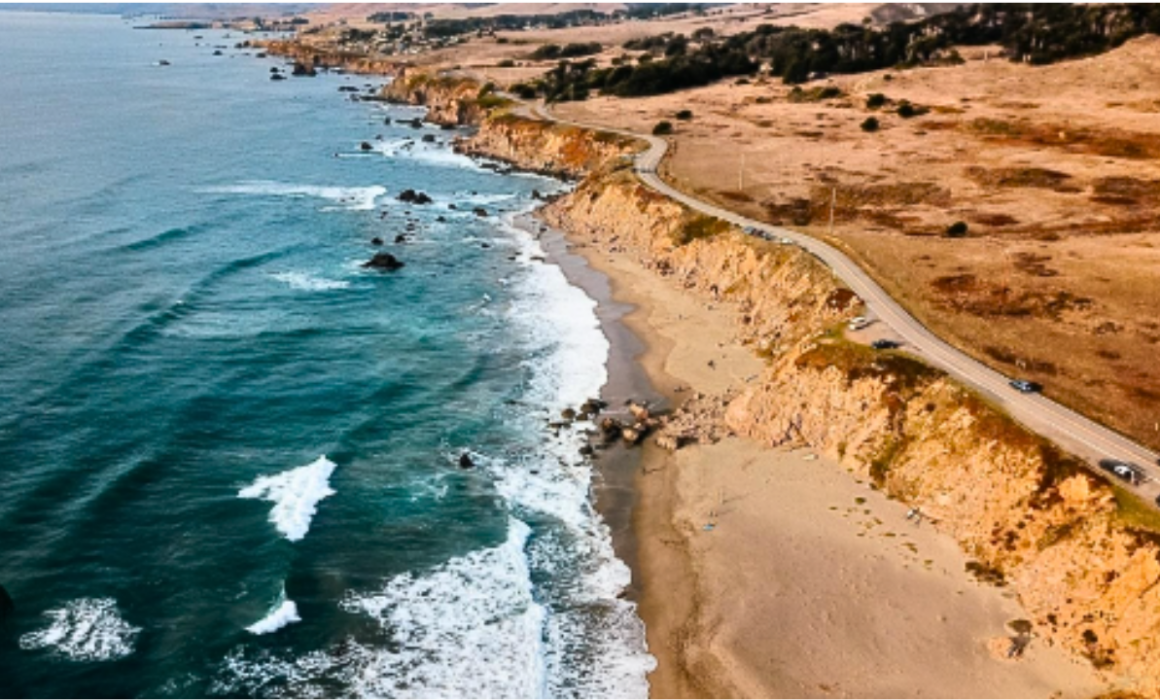
Photo By: Sonoma County Tourism
