
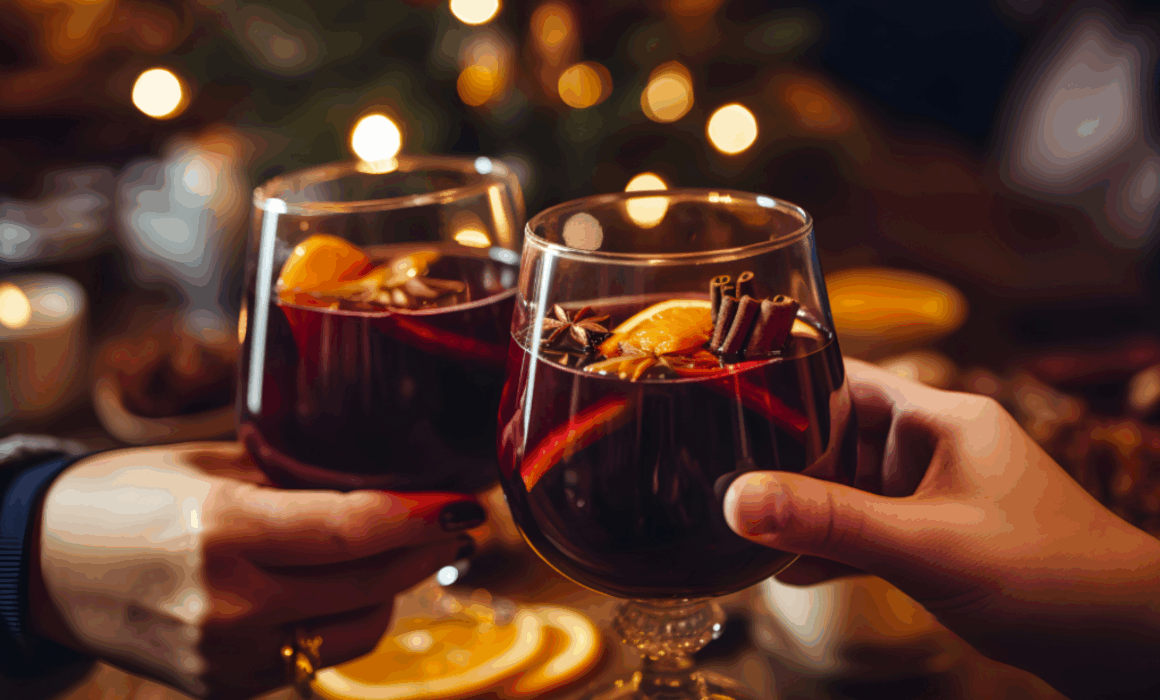
Mulled Wine for Christmas
By: Virginie Boone
Drinks writer Rosie Schaap says, “if coziness has a fragrance, it’s the aroma of red wine simmering on the stove with citrus and spices.” What she’s talking about is mulled wine, a warming wintry drink as old as time.
Schaap suggests choosing a red wine that isn’t bone dry, preferring one with a little fruitiness. Others say to use a bottle of Cabernet Sauvignon, Merlot, Tempranillo or Syrah.
Mulled wine combines oranges, red wine, sometimes brandy, dark brown sugar, cinnamon sticks, cloves and cardamom pods, slightly crushed. Star anise is another fun addition if you like the flavor of licorice. In place of brandy, you can opt for orange liqueur. When it comes to mulled wine – also known as Gluhwein, Glogg or Grog – the world is truly your oyster.
This ancient drink can be traced back to the Romans, who boiled wine with honey then added spices. It was long after believed to have medicinal properties, safer to drink than water. Adding rare and hard-to-afford spices marked a special occasion, like a wedding, when it was okay to splurge.
It seems to have been specifically tied to Christmas during the Victorian era, appearing in Charles Dickens’s 1843-written A Christmas Carol, as something called the Smoking Bishop, a version that’s still reliant on citrus (particularly bitter orange) and spice and mixed with port in this case.
The drink is toasted with near the end, Scrooge saying to Bob Cratchit, “A merrier Christmas, Bob, my good fellow, than I have given you, for many a year! I’ll raise your salary, and endeavor to assist your struggling family, and we will discuss your affairs this very afternoon, over a Christmas bowl of smoking bishop, Bob!”
Tasting History with Max Miller writes that the Smoking Bishop “comes mostly from an 1836 recipe from the delightfully pseudo-named Dick Humelbergius Secundus,” author of Apician Anecdotes or Tales of the Table, Kitchen, and Larder, a comprehensive book on food habits and dining customs from ancient times to the Victorian age.
Needless to say, a version appears in the Official Downtown Abbey Christmas Cookbook as well. Dickens’ own great-grandson Cedric Dickens provides his own recipes in Drinking with Dickens, in which he catalogs all the various drinks written about within the Dickens oeuvre.
But if you’re looking for more local inspiration, here are a few recipes from Sonoma County sources and a link to an ingenious spin on the drink:
A Very Merry Mulled Wine Recipe from the Museum of Sonoma County
Spiced Mulled Wine from St. Francis Winery
Photo By: St. Francis Winery
