The Late Great Johnny Brazil
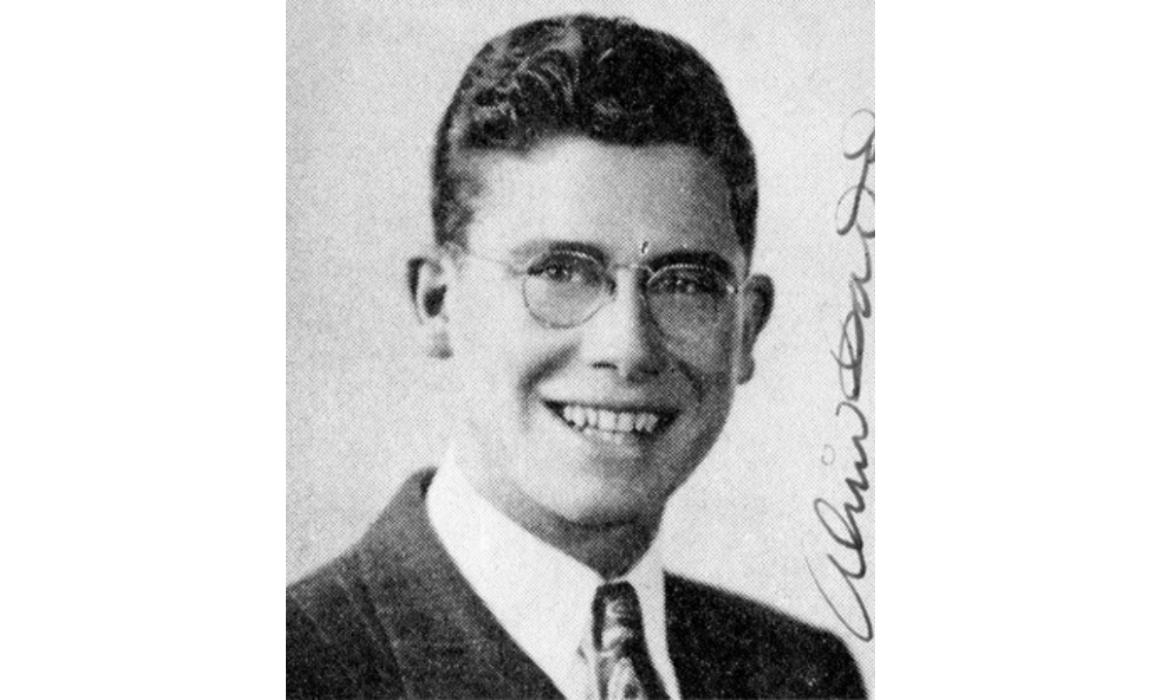
There are legendary horsemen all across America. Sonoma County was home to one of the best, a true cowboy, Johnny Brazil Jr. In this, the year of the fire horse, it seemed only right to give him his due.
Born in 1922 near Modesto and raised in Pinole where his dad raised dairy cows, for most of his life Brazil bred, raised, trained, showed and competitively rode horses, carrying forward the traditions of early California’s Spanish Vaquero for reining in cattle on ranches and open ranges. He also stormed the beaches of Normandy during World War II.
Spaniards brought horses and horsemanship to the Western United States and also inspired skills-based competitions. For many decades, these were some of the biggest competitions in the West. Brazil won more than 60 of them, from the Salinas Rodeo to the California State Fair.
He was such a force that in 1949, he helped write the bylaws for an organization known as the California Reined Cow Horse Association.
An exceptional trainer of champion hackamore horses and bridle horses, training and showing horses professionally well into his 90s, Brazil lived a sizable portion of his life in Northern Sonoma County.
Monty Roberts, a celebrated horse trainer in his own right and author of the best-selling “The Man Who Listens to Horses,” recalled this about seeing Brazil race in Salinas:
“In 1948 I clearly recall the first time I watched John Brazil Jr. competing on the competition grounds where I was born and raised. John won all three of the categories he competed for in that particular year. John, a small man of Portuguese descent, was immediately a hero for me. He rode as if he was part of the horse. Few riders could match his skills at high speed or with the precise maneuvers required.”
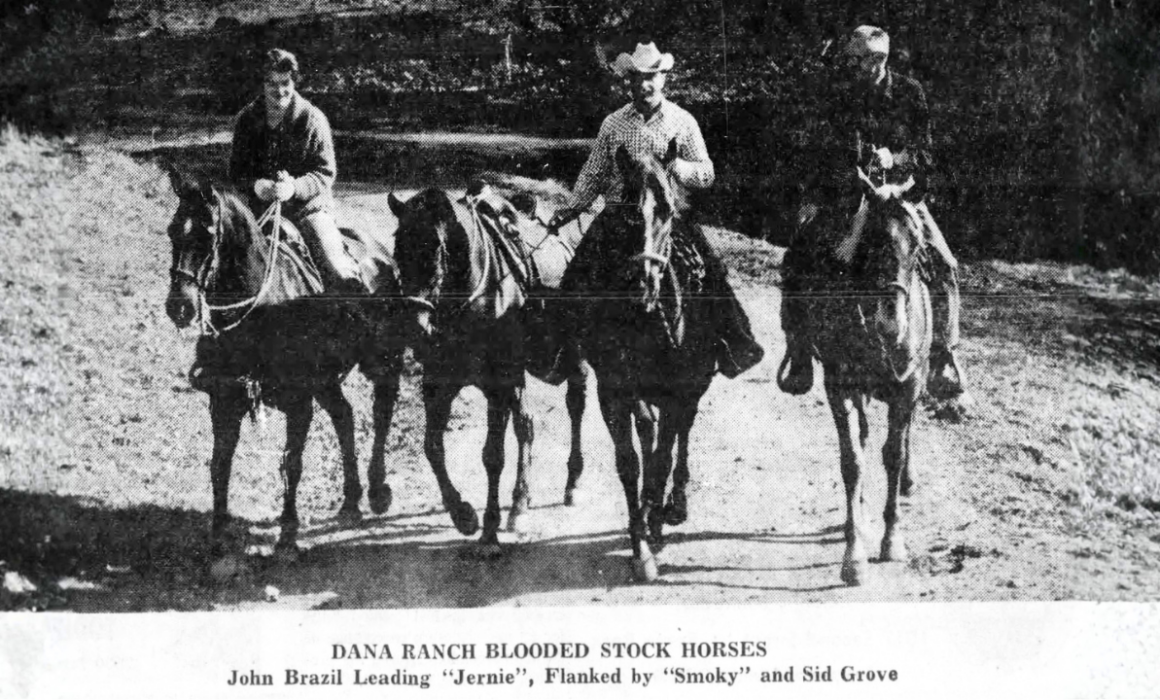
In his younger days Brazil worked for Cutter Laboratories, a West Coast company that was testing animal vaccines. His job was, of course, handling the cattle. Somewhere along the way in the 1940s the owner of New York’s Empire State Building, a man named William D. Dana, reached out to Brazil to help with a 6,000-acre cow-and-calf ranch Dana had purchased in Sonoma County called J Bar B Ranch.
A 1962 story in The Press Democrat described the property as ranging from the north rim of the Alexander Valley to the Geysers, plenty to nurture “beefy white-faced cattle.” But it also made note that the ranch was “perhaps better known for its stock horses, essential to handle cattle in that kind of terrain.”
Hired as Dana’s trainer-manager, Brazil raised, trained and looked over 30-40 horses at a time, the paper noting that “the J-B horses started to hit the big time when John Brazil joined the staff.”
Brazil worked for Dana until the older man died in 1964. Roberts ended up buying one of those horses. Its name was Night Mist and Roberts won many championships riding that horse, often competing against Brazil. The men became good friends over that time.
“I met individuals who had dozens of different personalities and acted with a variety when it came to integrity,” Roberts said. “John Brazil was and is the epitome of a gentleman… I never knew John Brazil to criticize anyone. This man inspired me to take on the promise to myself that I would never openly criticize another horseman by name in public.”
Brazil competed at the highest level well into his 70s, “a true testament to his talent and love for the horse.”
Watch an incredible video interview with Brazil at age 96 filmed in 2018. The incredible pioneer, legend and Sonoma County horseman Johnny Brazil passed away this March at the age of 104.
A thank you to Scott Newman of Newman Agriculture for telling me a bit about Johnny Brazil, Jr., who also worked with the Newman family in Knights Valley.