
A Half-Century and the Year of the Horse
By: Virginie Boone
The year 2026 is the Year of the Horse, a welcome turn of the page from last year’s time of the Snake.
Locally the Year of the Horse also marks the 50th anniversary of Iron Horse Vineyards. As if that wasn’t enough, it will also be matriarch Audrey Sterling’s 95th birthday (co-founder of the winery with her late husband Barry), and winemaker David Munksgard’s 30th Iron Horse vintage.
As second-generation founder Joy Sterling noted in an email, “Fifty years is never a given for any family business. It is especially rare in California wine. Vineyards demand a long view. Markets shift. Families evolve. To remain family-owned, estate-driven, and committed to excellence for five decades takes a deep respect for the land, the people, and the vision my parents set in motion.”
She also highlights how 1976 was such a watershed year for California wine, a year when several families in Northern California started to believe in the ability of American wines to compete on the world stage.
For the Sterlings that was a specific belief in the ability to make exceptional sparkling wines from the colder climes of the as-not-yet-official Green Valley of the Russian River Valley appellation, within the fogged-in folds of western Sonoma County. Here, Pinot Noir and Chardonnay could star.
What we now know as Iron Horse Vineyards was called Iron Horse Ranch and Vineyards when the Sterlings stumbled upon it in 1976, signing the deed to own it only two weeks later. The actual Iron Horse had been a steam engine that stopped at Ross Station long ago. The winery took another three years to build, opening in 1979.
“Warren and Gail Dutton were the first to welcome my parents,” notes Joy Sterling, “setting a tone of generosity that still defines this community.”
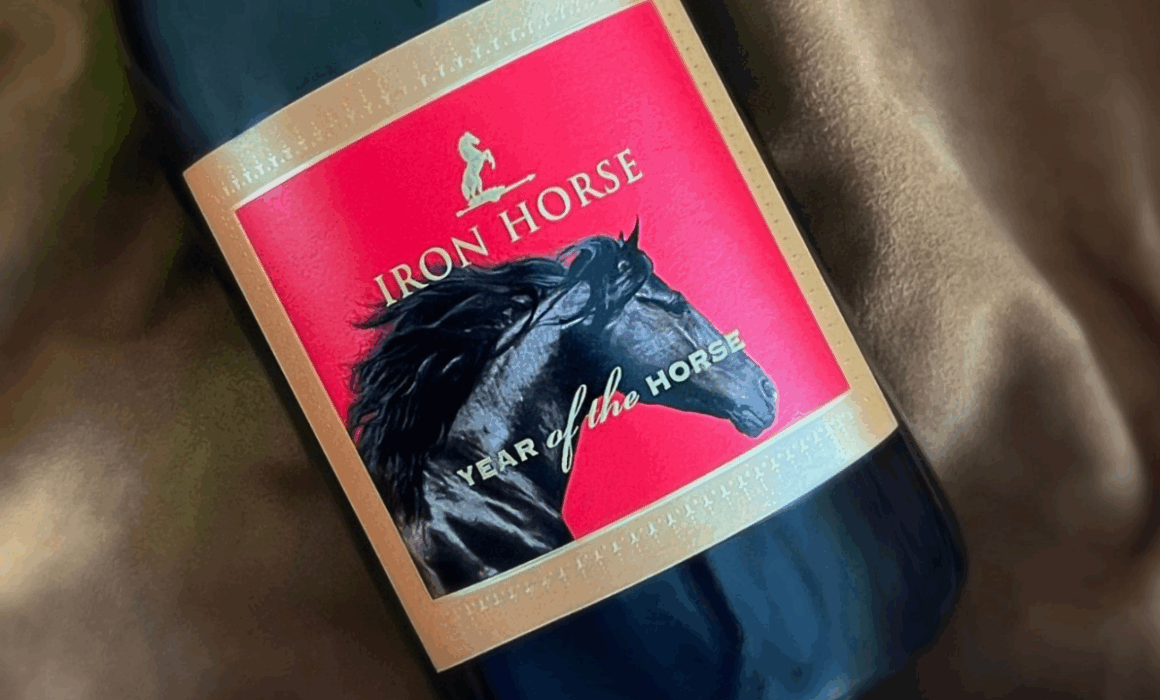
That community includes 14 team members who have been with the winery for two decades or more. Winery celebrations are planned for throughout the year, kicking off with a lunar new year celebration in San Francisco’s Chinatown in February. And a new wine has been released, a Brut Zero Year of the Horse Blanc de Blancs.
The Year of the Horse is anticipated to be full of vitality, momentum, and forward motion, as the horse symbolizes in lunar tradition. The Chinese calendar is lunar-solar, consisting of 12 months equal to 12 full lunar cycles in which months are referred to by number within a year and by a series of 12 animals that have been attached to years and to hours of the day, otherwise known as the Chinese zodiac.
The animals are rat, ox, tiger, rabbit, dragon, snake, horse, goat, monkey, rooster, dog, and pig, a 12-year cycle of animals that are also each specified by the five elements of wood, fire, earth, metal, and water. The year 2026 is in fact officially the Year of the Fire Horse and it begins February 17, 2026.
Vogue magazine states that in Eastern culture the horse represents action, freedom, speed, and breakthrough, a stage of life that moves boldly forward without the fear of obstacles, with an emphasis on being in motion rather than standing still – though clarifying that “The Horse is not afraid of slowness, it’s afraid of stillness.”
The fire part of the equation equals energy and dynamism. This is the first fire horse in 60 years. Last year was Year of the Wood Snake, representing a shedding of old stories and habits.
The year 1976, when the Sterlings bought Iron Horse, was the Year of the Fire Dragon. As many know, the dragon holds a significant place in Chinese culture, and is considered an extraordinary creature symbolizing power, nobility, honor, luck, and success.
That fire dragon spirit is on full display when you consider that 1976, America’s Bicentennial, was well before California had much in the way of an appellation system. It took until 1981 (five years after the Judgment of Paris) for Napa Valley to be established as an American Viticultural Area (AVA). Sonoma Valley became official in 1982.
The following year, 1983, saw six more Sonoma County AVAs come to life: Chalk Hill, Dry Creek Valley, Knights Valley, Los Carneros, Green Valley, and Russian River Valley (Green Valley became Green Valley of Russian River Valley in 2007).
Green Valley of RRV includes 19,010 acres. It was the Sterling family who first applied for Green Valley AVA status, inspired by the European wine regions where they had spent time, mostly France.
The rest is now 50 years of history for Iron Horse in this the Year of the Fire Horse. Let that spirit of hard work, bravery, and resilience carry it forward another 50 years.
Photo By: Iron Horse Vineyards
