
The Rise and Rise of Sonoma County Pinot Noir
By: Virginie Boone
In the 1928 Crop and Acreage Report of Sonoma County, the first one for which there exists a digital record, there were 20,000 acres of grapes (valued at $1.4 million by the way), unclear whether or not they were wine grapes, let alone varietal wine types.
In the early 1950s, grapes were broken down by Black (the majority) and White, or later, by Common and Premium. By the 1960s, you start to see grapes by type with Alicante Bouschet, Burger, Carignane, Golden Chasselas, Petite Sirah, Sauvignon and Zinfandel making the list.
Eventually, Pinot Noir started to bubble.
“By 1960, Pinot Noir was firmly, if still marginally, established in the production portfolios of California’s premium wineries,” writes John Winthrop Haeger in North American Pinot Noir.
“Louis Martini pioneered Pinot Noir plantings in Los Carneros in the 1940s,” he continues, “when he acquired part of Judge Stanly’s Riverdale ranch. The first trial blocks of Pinot Noir there date to 1946. Martini’s plantings grew to about 70 acres in the 1950s and probably constituted the state’s largest single investment in Pinot Noir before 1960.”
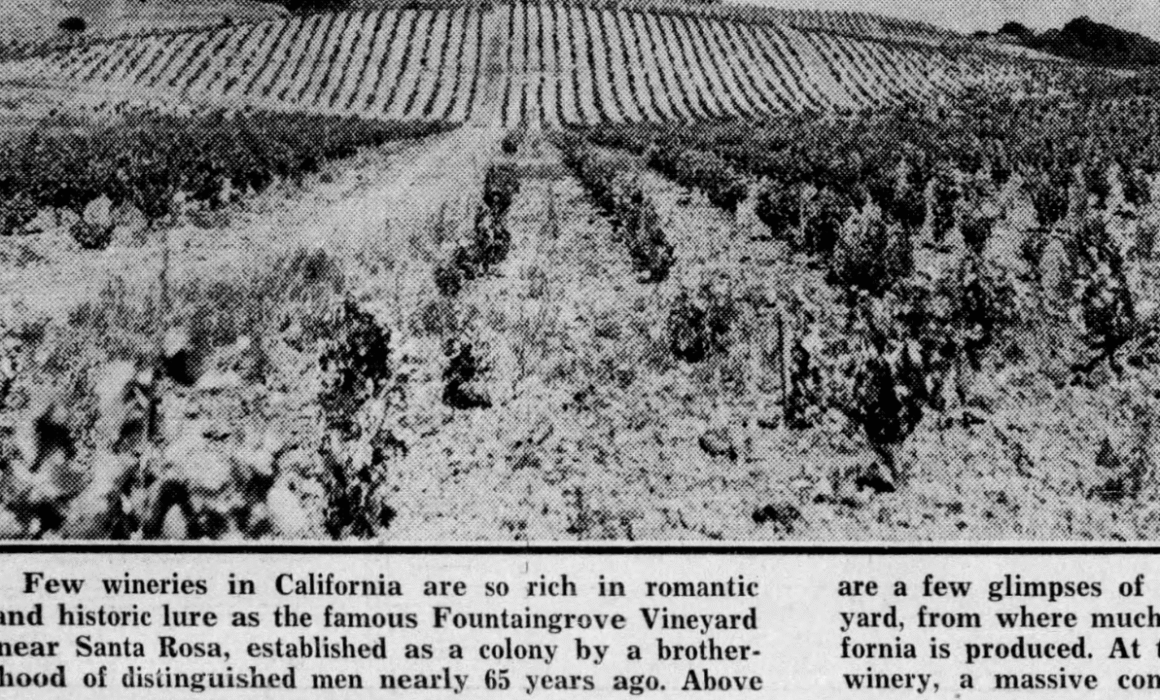
Haeger also mentions Fountaingrove Vineyards and Winery, “long recognized both as one of the county’s most noted scenic showplaces and as one of California’s outstanding producers of choice dry wines,” according to a 1937 article in The Press Democrat, which also described it as “rich in romantic and historic lure… established as a colony by a brotherhood of distinguished men nearly 65 years ago.”
By 1941, it had 400 acres of Pinot Noir on the northern hillsides along the Redwood Highway in Santa Rosa, making it the biggest Pinot vineyard of its time. Purchased in 1875 by Kanaye Nagasawa, the 1,931-acre Fountaingrove at its height had 400 acres of wine grapes, 50 acres of orchards, 175 acres of hay and grain, and the rest in pasture lands. Nagasawa died in 1934, at which time the estate was run by his nephews.
By 1953, Fountaingrove was uprooted and sold for housing.
That same year, Hanzell established itself on the hills of what is now the Moon Mountain District overlooking the town of Sonoma. It would take another decade or so before, “for a tiny band of contrarians, the dismal condition of 1960s and 1970s Pinots was a call to arms.”
Hanzell was among them, so were the owners and winemakers of Chalone on the borders of Monterey and San Benito counties, including a just-graduated-from-UC Davis Merry Edwards. Joseph Swan planted Pinot Noir near Forestville in 1969. Josh Jensen started planting Pinot at Calera in the Gabilan Mountains near Chalone in 1975. Oregon Pinot also got going around this time.
Interest in sparkling wine caused Pinot Noir to further boom in Sonoma County, particularly in Carneros, where Gloria Ferrer and others set up sparkling houses, and cooler pockets of the Russian River Valley/Green Valley of Russian River Valley, where Iron Horse, Piper-Sonoma, J Vineyards and Korbel could be found.
Pinot Noir shows up in the crop reports more steadily during the 1970s, with a scant 265 acres in 1970 nearly quintupling to 1,301 acres by 1975. This is the era of Dehlinger, Davis Bynum, Rochioli and Gary Farrell, among others.
Soon enough, Decanter was declaring California Pinot Noir to have “experienced a rebirth,” adding, “Pinot Noir is the hottest wine type around.” Dorothy Gaiter and John Bucher of The Wall Street Journal wrote about “discovering” good California Pinot Noir in 1981.
“A key feature of the Pinot renaissance was a preoccupation, on the part of winemakers and critics alike, with site,” Haeger stated.
It helped that America during this time was focusing on food and wine in new and wonderful ways, with sommeliers becoming early adopters of American Pinot Noir.
“By the late 1980s, sommeliers were bumping Cabernets to make room for the hot new Pinots, and began to preach the gospel to their customers, praising Pinot and winning some converts,” recalled Michael Bonadies, an international hospitality expert who ran successful restaurant groups at the time.
Sonoma County soon had the likes of Williams-Selyem, Littorai, Peter Michael, Hirsch, Martinelli, Hartford Court, Marcassin, Dutton-Goldfield, Lynmar, Merry Edwards, Siduri, Kosta-Browne, Donum, Flowers, Cobb, Patz & Hall, Scherrer, Failla, Peay and others winning those converts on wine lists across the country.
By 2008, there were 10,000-plus acres of Pinot Noir in Sonoma County. The amount has hovered around 12,000-13,000 acres or so ever since. In 2023, perhaps its most recent height, the 13,024 acres/55,159 tons of Pinot Noir planted here were worth just over $214 million.
Today, no wine grape has as high a total value in Sonoma County as Pinot Noir, whether it sits in the Russian River Valley, Green Valley of Russian River, Sonoma Coast, West Sonoma Coast, Fort Ross-Seaview, Petaluma Gap, Sonoma County portion of Carneros, or any other AVA within the region’s confines.
So it’s important to remember that Pinot Noir has had its ups and downs throughout its time in California, but Sonoma County remains one of its chosen lands, a place where it thrives in sites big and small.
